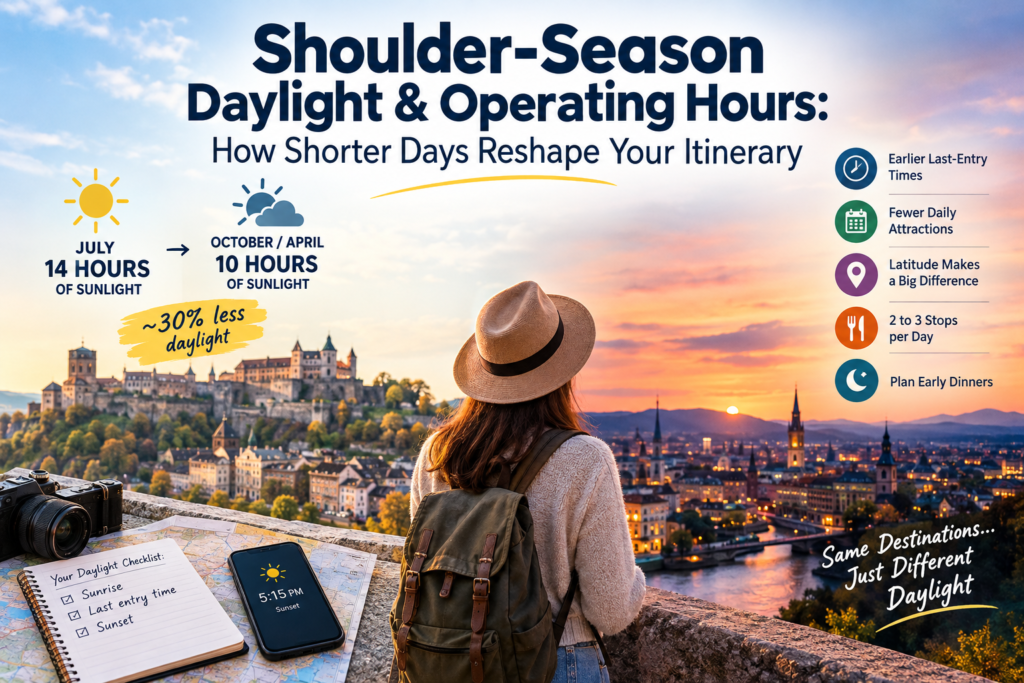
Key Takeaways: The Daylight Reality
- The 4-Hour Daylight Deficit: A destination boasting 14 hours of sunlight in July often drops to just 10 hours in October or April, stripping away roughly 30% of your usable outdoor sightseeing window.
- The Last-Entry Trap: Attractions do not simply close earlier; they enforce strict last-entry cutoffs up to 90 minutes before sunset for safety and staffing reasons.
- Latitude Dictates Impact: The further north or south you travel from the equator, the steeper the daylight drop-off. Northern Europe and Canada see dramatic shifts, while the tropics barely change.
- The 2-to-3 Stop Rule: Discard your 4-stop summer itinerary. Limit shoulder-season days to 2 major sights and schedule dinner reservations early as evening dining hours contract.
While weather and precipitation dominate shoulder-season conversations, daylight hours quietly exert an equally profound influence on your vacation experience. A mild 65°F (18°C) afternoon is wonderful for exploring, but if darkness arrives by 5:15 PM, your effective window for hiking, outdoor photography, and walking between neighborhoods shrinks dramatically.
Compounding the shorter days, tourism infrastructure scales its operational schedules around available daylight rather than a fixed clock. Castles, botanical gardens, ruins, and open-air museums frequently shift from daily summer operations to 4-day weekly schedules, with early last-entry gates that can catch unprepared travelers off guard. Adapting your pacing is the secret to getting the most out of shorter days.
Peak vs. Shoulder Pacing: How Your Day Must Change
The Latitude Multiplier: Why Geography Determines Day Length
The severity of seasonal daylight loss correlates directly with your distance from the equator:
- Equatorial & Tropical Latitudes (<25°): Destinations like Costa Rica, Hawaii, or Thailand see minimal day-length variation across the year (often less than an hour’s difference between July and November).
- High Latitudes (>45°): Destinations like Scotland, Scandinavia, Canada, or southern New Zealand experience drastic shifts. An October trip can lose over 4 hours of daylight compared to summer, turning whole afternoons dark before dinner.
4 Operational Bottlenecks Caused by Shorter Days
1. The “Last Entry” Cliff
Many historical sites, botanical gardens, and national parks close gates 60 to 90 minutes before sunset. If sunset is at 5:00 PM, the final admission is frequently 3:30 PM. Arriving at 3:45 PM means being turned away at the ticket counter.
2. Compressed Morning Windows
A late 7:30 AM sunrise delays the start of outdoor exploration. Combined with hotel breakfast schedules and transit times, your first real sight might not be reached until 9:30 AM, leaving barely six hours of premium daylight remaining.
3. Civil Twilight as a Buffer
Do not treat sunset as a hard stop. “Civil twilight”—the 25 to 40 minutes of ambient natural light after sunset—is ideal for strolling through historic plazas, browsing outdoor markets, or heading to your evening restaurant without needing a flashlight.
4. Early Evening Dining Closures
In seasonal towns where foot traffic drops off after dark, restaurants often cut staff and close kitchens by 8:30 PM rather than staying open until midnight. Always verify evening dining hours rather than assuming peak summer flexibility.
The 3-Metric Pre-Trip Daylight Worksheet
Before locking in your daily plans, write down these three numbers for every day of your trip:
Determines when transit to your first sight begins.
Sets your mandatory afternoon arrival deadline.
Signals the hard cutoff for trails and scenic viewpoints.
The 5-Minute Night-Before Confirmation
Because attractions frequently alter shoulder-season opening hours with little notice, make it a habit to check tomorrow’s official Google Maps or website operating hours the night before from your hotel room.
Confirming that a museum is open on a Tuesday or that a castle’s last entry is 4:00 PM takes two minutes, preventing a wasted 45-minute train ride or an afternoon of frustration.
Frequently Asked Questions (FAQ)
1. How much do daylight hours actually decrease between summer and shoulder season?
It depends entirely on latitude. In mid-to-high latitudes (Europe, northern USA, Canada), day length drops from 15–16 hours in June to approximately 10–11 hours in October—a loss of 4 to 5 hours of usable sightseeing light per day.
2. Why do attractions enforce earlier last-entry cutoffs in shoulder season?
Safety regulations and reduced staffing. Historical sites and outdoor gardens want all tourists cleared from unlit pathways and ramparts before dusk settles, forcing earlier ticket gate closures.
3. Does shorter daylight mean a shoulder-season trip is less enjoyable?
Not if planned properly. Shorter days encourage a relaxed, high-quality pace. You enjoy leisurely dinners, cultural performances, museum visits, and atmospheric evening walks without the exhaustion of 14-hour summer sightseeing sprints.
4. What is ‘civil twilight’ and how does it help travelers?
Civil twilight is the window after sunset (typically 25–40 minutes) when the sun is just below the horizon, but ambient sky light is still bright enough to navigate streets without artificial illumination. It provides valuable buffer time to reach dinner or an indoor venue.