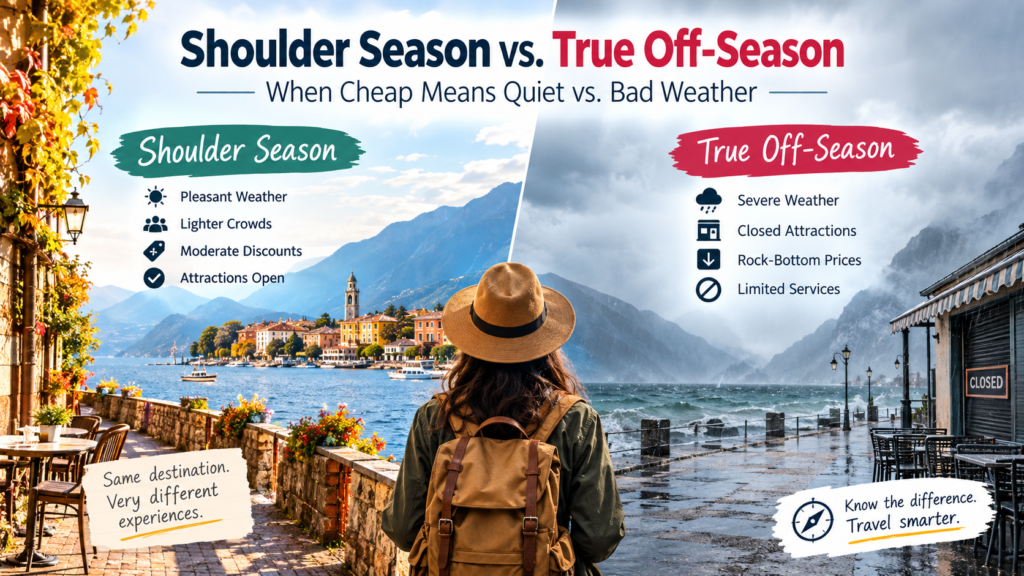
Key Takeaways: Decoding the “Off-Season” Label
- The Essential Distinction: Shoulder season means lighter crowds, moderate discounts, and pleasant, functional weather. True off-season means severe weather, closed mountain passes, unswimmable water, or shuttered attractions.
- Marketing Engines Blur the Line: Hotel booking platforms use “off-season” to describe low demand, not mild weather. A 50% discount could mean peaceful, crisp autumn days or a relentless monsoon flooding roads.
- Subjective Seasonality: A destination can be in shoulder season for a cultural tourist or photographer, but in true off-season for a sunbather or scuba diver. Your travel purpose determines the season.
- The “No-Price” Gut Check: Describe your planned trip in one sentence without mentioning money. If the trip still sounds wonderful, you are looking at shoulder season. If it requires an asterisk about hoping the rain stops, it is true off-season.
The term “off-season” is used loosely across the travel industry to describe any date outside the peak summer or holiday rush. However, grouping every low-demand week into a single category creates severe travel planning pitfalls. There is a vast difference between visiting a destination during a quiet, atmospheric week with mild temperatures and arriving in the middle of a seasonal monsoon that brings daily life to a halt.
Because automated flight and hotel algorithms discount rooms purely on customer demand rather than meteorological comfort, a rock-bottom price tag tells you nothing about the actual conditions on the ground. Learning how to distinguish between genuine shoulder season and true off-season is the single most important skill for securing real travel value.
Shoulder Season vs. True Off-Season: The Critical Differences
The 3-Question Audit: How to Verify Before Booking
1. What Is the Actual Temperature Shift?
A drop of 4°F to 8°F from summer peak indicates pleasant, crisp shoulder weather. A drop of 20°F+ (or a plunge below 45°F / 7°C) signals true off-season winter conditions requiring full thermal gear and heated accommodation.
2. How Acute Is the Precipitation Risk?
Does the destination face a few overcast rain days, or does the month coincide with the peak of hurricane, typhoon, or monsoon season? Check historical rainfall distribution in days, not just abstract volume figures.
3. Does the Core Experience Still Function?
Why are you traveling there? If you are going to a beach resort where ocean water has cooled to 60°F, swimming is out of the question. If the core activity is disabled, the destination has entered true off-season for you.
Why Seasonality Depends on Your Personal Goals
A single week can be shoulder season for one traveler and true off-season for another. Consider a coastal town in late October:
- For the Swimmer & Sunbather: It is true off-season. Beach umbrellas are packed away, ocean water is freezing, and open-air beach clubs are boarded up.
- For the Landscape Photographer & Hiker: It is prime shoulder season. The trails are deserted, hotel rates are down 35%, and dramatic autumn sea mists produce world-class photographs.
When True Off-Season Is Actually the Better Choice
True off-season is not inherently bad. For travelers with realistic expectations and adaptable itineraries, severe off-peak travel offers unparalleled cultural intimacy:
- Complete Tourist Evaporation: Standing inside iconic cathedral squares, historic ruins, or gallery halls without selfie sticks or tour groups creates a profound, personal connection to a city.
- Dramatic Atmospheric Landscapes: Coastal storms, moody fog rolling across mountain valleys, and lush rain-fed waterfalls produce striking visual memories far more memorable than flat midday summer sun.
- Unmatched Luxury Affordability: Five-star historic hotels that charge $800/night in peak season frequently drop to $180/night in true off-season, offering world-class hospitality on a backpacker’s budget.
The 1-Sentence “No-Price” Gut Check
To eliminate financial bias when evaluating a cheap hotel quote, summarize your upcoming trip in one sentence without mentioning the price:
If that sentence excites you, book it immediately—you have found genuine shoulder season. But if your sentence sounds like: “We will be sitting in the hotel hoping the rain stops so we can walk to the beach,” you are looking at true off-season. Only book if you are willing to embrace the trade-off deliberately.
Frequently Asked Questions (FAQ)
1. Is true off-season travel always a mistake?
No. It is only a mistake if you expect peak-season activities during off-season conditions. If you travel with an indoor-focused itinerary (dining, galleries, wellness, cultural events), true off-season offers unmatched peace and savings.
2. Why do hotel booking sites label terrible weather months as ‘off-season bargains’?
Booking platforms track consumer search volume and room occupancy algorithms, not the weather forecast. When demand plummets due to freezing winds or monsoon downpours, the platform automatically tags the low rate as an attractive discount.
3. How can I verify what is actually open during true off-season?
Search travel forums (such as TripAdvisor or Reddit’s travel communities) for trip reports posted within the last 30 to 60 days. Recent travelers will provide real-time status on ferry schedules, open restaurants, and local trail conditions.
4. How should an itinerary be structured differently for true off-season?
Design your days around indoor cultural activities as the primary default (museums, historic libraries, cooking classes, thermal baths). Treat outdoor sightseeing as an opportunistic bonus when pleasant weather windows emerge.