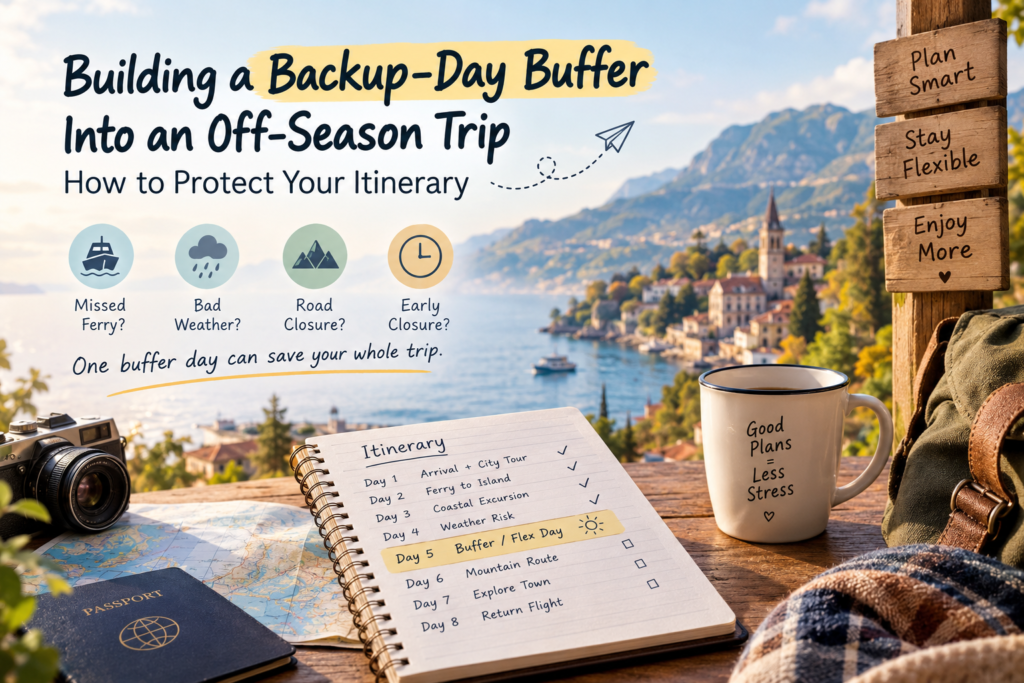
When planning a vacation months ahead, scheduling a completely empty “buffer day” often feels like wasted time and wasted money. In high season, you rarely need one: transit runs constantly, tour operators operate at full staffing, and venues stay open late. But shoulder season strips away those safety nets. A single missed once-daily ferry, an unseasonal rainstorm, or an early ticket-office closure can immediately trigger a domino effect that collapses the rest of your trip without built-in slack.
🛡️ Key Takeaways: The Mechanics of a Travel Buffer
- Place it immediately after the highest-risk leg: Never stash your buffer day at the very end of a vacation. Position it right behind the single-departure ferry or weather-sensitive tour.
- Do not pre-book non-refundable activities: A buffer day functions only when it remains 100% flexible. The moment you schedule rigid tickets, it ceases to be a buffer.
- Budget as a sunk cost: Include hotel and meal expenses for that day in your baseline budget. If no delays happen, it becomes a welcome, zero-pressure rest day.
- Protect the empty space from groups: Label the day explicitly as “Flex / Recovery” so travel companions do not pack it with optional excursions before you depart.
Where to Place Your Buffer Day for Maximum Protection
The single biggest mistake travelers make is placing their buffer day at the absolute end of the itinerary right before the return flight. If a transit disruption or mountain road closure hits on Day 3, a buffer day scheduled on Day 8 cannot save Days 4, 5, and 6 from being cancelled or scrambled.
Strategic buffer placement requires identifying the single point of failure in your itinerary:
What Disruptions Does a Buffer Day Actually Absorb?
A buffer day is not intended for catastrophic trip cancellations—travel insurance handles those. It is engineered to absorb three predictable frictions unique to off-season travel:
- 1. Slashed Transit Frequency: In July, missing a coastal ferry means grabbing a coffee and boarding the next vessel 45 minutes later. In November, missing the 10:00 AM sailing means waiting until 10:00 AM the next morning. A buffer absorbs that missing 24 hours without cutting into downstream bookings.
- 2. 24-Hour Weather Slides: High winds frequently shut down cable cars, boat ferries, and coastal coastal boat charters for exactly one day. With a buffer day positioned immediately after, operators can easily slide your booking forward by 24 hours without forfeiting deposits.
- 3. Truncated Operating Windows: Shoulder-season tourist desks, car rental depots, and historical sites often close at 2:00 PM or 4:00 PM instead of 8:00 PM. Arriving thirty minutes late pushes that visit to tomorrow—which your buffer cleanly accommodates.
1. Keep Two “Zero-Cost” Plans Ready
If nothing goes wrong and weather is ideal, never let the buffer day feel aimless. Prepare two zero-obligation ideas: a low-effort local walk (e.g., exploring neighborhood bakeries or public gardens) and a guilt-free sleep-in/reading afternoon.
2. Name It on the Group Itinerary
When traveling with friends or family, an empty calendar day invites suggestions. People will instantly book day trips into that slot. Label it explicitly as “Flex / Rest Day” on the itinerary so everyone respects its protective function.
3. Split Buffers on Multi-Week Trips
For itineraries exceeding 10 days that cross multiple climates (e.g., moving from the coast to alpine mountains), a single buffer day leaves one leg exposed. Divide the time into two half-day flex windows positioned across both regional transitions.
4. Budget the Day Honestly
An unscheduled day still carries lodging, food, and local transit costs. Treat those baseline numbers as fixed sunk costs. Never feel pressured to book paid museum tickets or tours just to “justify” the hotel bill.
⚠️ When You DO NOT Need a Dedicated Buffer Day
Not every getaway justifies a full empty day. For trips under 4 days, dedicating 25% of your time to a buffer is inefficient. Similarly, dense metropolitan hubs with underground metro lines, high transit frequencies, and year-round indoor museums do not carry single-point-of-failure transit risks. Save full buffer days for rural, coastal, island, and mountainous itineraries.
Frequently Asked Questions
How many buffer days should a shoulder-season trip include?
For standard trips lasting between 7 and 10 days, one well-placed buffer day positioned after your highest-risk transit or weather leg is ideal. For extensive two- to three-week multi-region itineraries, incorporating two distinct flex days (or two half-day buffers) provides balanced coverage without slowing momentum.
Is a buffer day worth it for a short 3- to 4-day weekend trip?
Sacrificing an entire day on a 3-day trip is rarely practical. Instead, build “micro-buffers”—leave mornings or afternoons unscheduled, and avoid booking back-to-back non-refundable timed tours. Give yourself a 3- to 4-hour window between transit arrivals and scheduled activities.
What should we do on a buffer day if the weather is clear and no delays occurred?
An unused buffer day is a success, not a failure. Use it as an unhurried exploration day: linger at local cafes, stroll unvisited residential neighborhoods, do laundry, or revisit your favorite spot from earlier in the week without checking a watch.
Should I book accommodation for the buffer day in advance or wait until I arrive?
Always book your lodging in advance, preferably at the hub where you are spending the night before the buffer. The buffer day is about schedule flexibility, not wandering without a bed. Having a guaranteed room eliminates unnecessary stress and provides a stable staging ground whether you rest or explore.