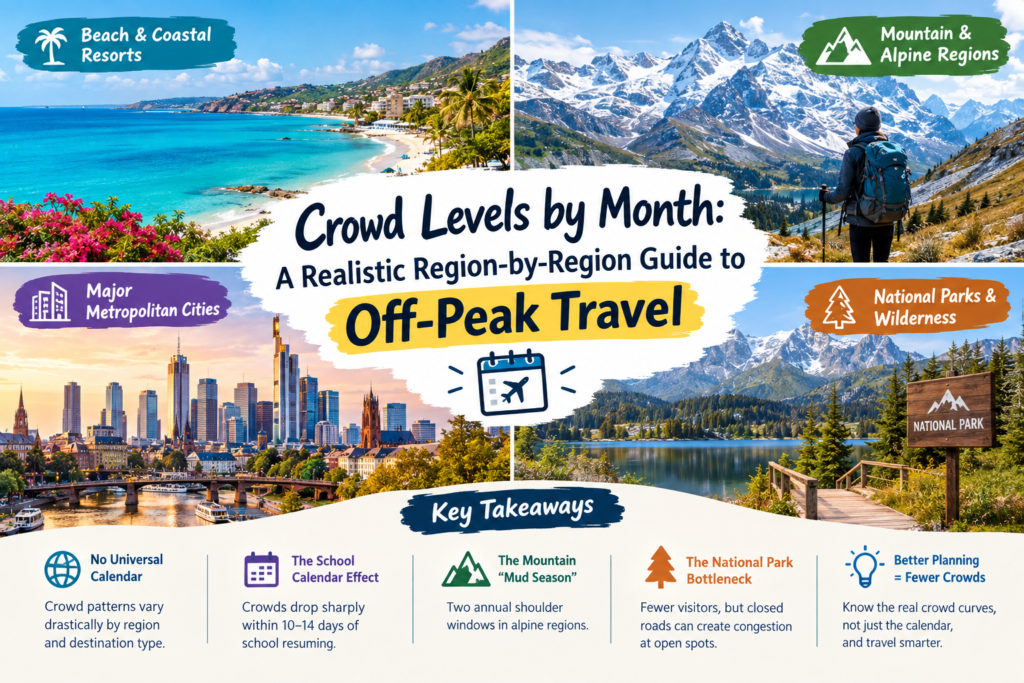
Key Takeaways: Demystifying Tourist Crowds
- No Universal Calendar: Tourist crowds do not disperse at the same time worldwide. A coastal beach town, a high-altitude ski resort, and a metropolitan capital follow completely distinct crowd trajectories.
- The School Calendar Effect: Tourist volume drops precipitously within 10 to 14 days of regional schools resuming in autumn, even when summer weather remains 100% intact.
- The Mountain “Mud Season”: Alpine regions feature two distinct shoulder windows per year—the awkward seasonal transition between melting ski snow and dry hiking trails.
- The National Park Bottleneck: Park visitor totals may drop by 40%, but if seasonal snow closes 60% of roads, the remaining tourists get compressed into fewer viewpoints, making open areas feel crowded.
Travel guides frequently recommend “shoulder season” as if it were a single, universally synchronized calendar window across the globe. In reality, crowd density follows the specific economic and recreational magnet that draws people to a destination in the first place. What empties out a beach resort in September does not apply to a cultural capital or a national park.
By understanding how different regional ecosystems behave, travelers can identify the exact calendar weeks where tourist density plummets while weather conditions and local hospitality remain at their peak. Here is how crowd curves move across four distinct destination categories.
The 4 Core Tourist Crowd Curves
4 Critical Crowd Dynamics Travelers Overlook
1. The Mountain “Mud Season”
Unlike beach towns with one post-summer lull, mountain communities experience two annual shoulder gaps: April/May (when ski lifts shut and trails are muddy slush) and October/November (before ski resorts open). Rates plunge by 50%, but gondolas and trailheads close for maintenance.
2. The Park Bottleneck Paradox
In major nature reserves, overall visitor counts drop by half in autumn. However, if early snowfall closes 70% of mountain passes, the remaining visitors all converge on the single accessible valley loop or parking area. A park that looks quiet on paper can still feel choked at its open viewpoints.
3. The School Calendar Drop
The sharpest crowd drop of the year is driven by school resumption dates rather than weather changes. The first two weeks of September in Europe and North America offer mid-summer weather with zero family lines, making it the highest-value travel window on the calendar.
4. City Convention Spikes
Metropolitan cities don’t empty out simply because summer ended. A single 40,000-person medical congress or tech expo in Frankfurt, Chicago, or Singapore can instantly sell out all central hotels and crowd neighborhood restaurants during an otherwise quiet November week.
Why Price Drops and Crowd Drops Diverge
Many travelers assume that cheaper prices automatically mean empty streets. In reality, hotel revenue managers update rate bands months ahead based on historical averages, whereas actual crowds fluctuate based on real-time factors:
- Lagging Price Drops: Popular tourist hotspots (like Venice or Santorini) can remain crowded well into October while hotels stubbornly keep rates high until late November.
- Immediate Clearance Deals: Secondary beach destinations drop prices immediately on September 1st, even though sunshine and swimmable waters persist for another month.
Regional Variation Within a Single Country
Never rely on a broad “Best Time to Visit [Country]” guide. Diverse nations feature multiple regional micro-climates and tourism seasons operating simultaneously:
- Coast vs. Mountain: In Italy or Spain, coastal beaches empty out by late September, while nearby alpine climbing routes and wine harvest valleys enter their busiest peak period of the year.
- North vs. South: In Japan, Hokkaido experiences chilly late-autumn conditions while Okinawa continues to offer balmy subtropical beach swimming in the same week.
- Islands vs. Mainlands: Island communities depend on ferry logistics that shut down early, whereas mainland cultural hubs maintain full ground rail connections year-round.
Frequently Asked Questions (FAQ)
1. What exactly is ‘mud season’ in mountain resort towns?
Mud season is the transitional lull between winter skiing and summer hiking (typically April through May, and again in November). Melting snow creates boggy trails, ski lifts close for annual overhaul, and many resort restaurants take seasonal staff vacations.
2. How can I avoid unexpected crowd surges in major cities?
Always check the city’s official convention center and expo schedule before booking. If an international industrial trade fair or major marathon is scheduled for your dates, hotel rates will be inflated and public transit will be congested.
3. Why is early September considered the best shoulder travel window?
Because school districts across Europe and North America resume classes right after Labor Day. Family tourists vanish overnight, cutting lines in half, while ocean waters and afternoon temperatures remain summer-warm.
4. Why do national parks feel crowded even in the off-season?
Because park authorities close seasonal access roads and high-elevation trailheads due to ice or wildlife management. Even with fewer total cars entering the gates, every visitor is funneled into the few remaining open parking lots.