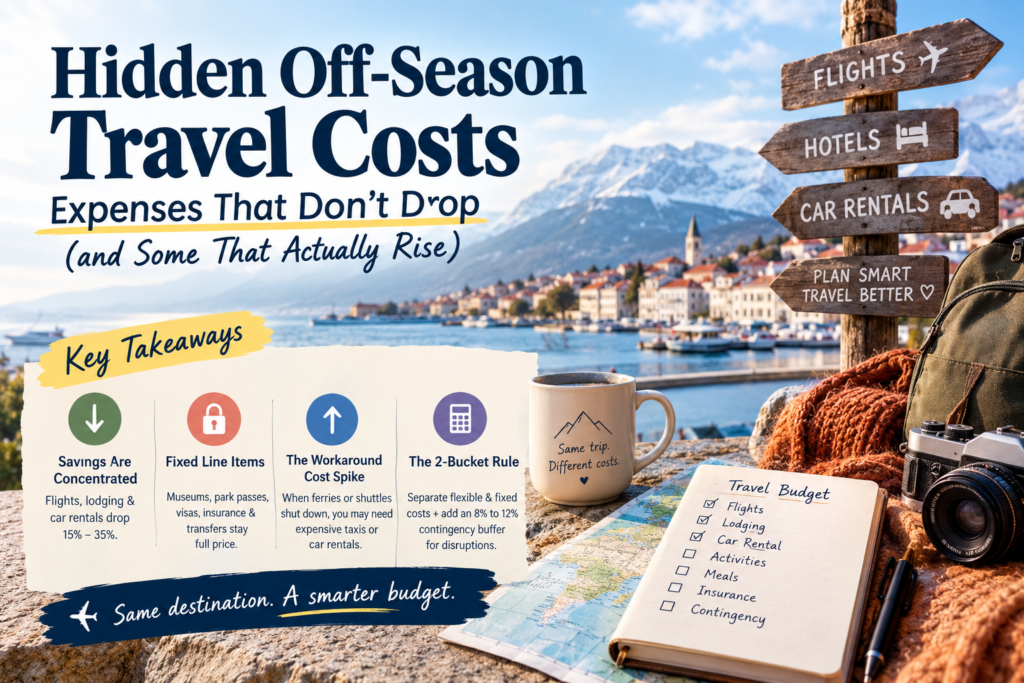
Key Takeaways: The Budget Reality Check
- Savings Are Concentrated: Price drops cluster almost exclusively in flights, lodging, and car rentals. Assuming other line items scale down automatically is a guaranteed way to blow your budget.
- Fixed Line Items: Museum entries, national park passes, visa fees, travel insurance, and pre-booked airport transfers never reduce rates for off-season visitors.
- The “Workaround” Cost Spike: When low-cost seasonal ferries or public shuttles shut down, you may be forced into expensive private taxis or car rentals.
- The 2-Bucket Rule: Separate your budget into “flexible” (discountable) and “fixed” (full-price) expenses, adding an 8% to 12% contingency buffer for seasonal disruptions.
It is easy to assume that every line item on a vacation budget drops the moment peak tourist crowds thin out. While flight fares and vacation rental rates reliably decline, several essential travel expenses remain completely flat. Worse, specific off-season constraints can quietly cause day-to-day spending to spike higher than expected.
Travelers who build their off-season projections by applying a flat 25% or 30% discount across their entire itinerary frequently find themselves over budget by the third day. To protect your finances, you need to understand which expenses stay rigid, which ones introduce hidden replacement costs, and how to structure a realistic, two-bucket travel budget.
Off-Season Expense Behavior: What Drops vs. What Stays Flat
The 2-Bucket Budgeting Blueprint
To avoid unpleasant financial surprises, divide your travel budget into two separate planning buckets rather than applying a single universal discount rate:
Bucket 1: Flexible Costs (Apply Discounts)
Expenses driven directly by private commercial demand:
- Airfares & Rail Tickets
- Hotel Rooms & Vacation Rentals
- Rental Car Daily Base Rates
Estimated Discount: 15% to 35% below peak quotes.
Bucket 2: Fixed Costs (Price at 100%)
Expenses dictated by institutional policies or fixed overhead:
- Museum, Gallery & Historical Site Tickets
- National & State Park Entrance Fees
- Consular Visas & Mandatory Border Taxes
- Comprehensive Travel Medical Insurance
- Fixed-Rate Airport Transfers & Local Subway Fares
Estimated Discount: 0% (Calculate at full current rates).
4 Quiet Ways Off-Season Trips Become More Expensive
1. The “Workaround” Cost from Seasonal Closures
This is the single most common cause of off-season budget overruns. If a seasonal passenger ferry linking two islands stops running in October, you may be forced to take a costly connecting flight or hire a private water taxi. A closed mountain pass can add four hours of driving, doubling fuel costs and toll fees.
2. The Casual Dining Disappearance
Restaurant menus do not print cheaper prices during the off-season. What actually changes is the availability of affordable options. Budget food stalls, street vendors, and casual sandwich shops frequently close for the winter, leaving only upscale hotel dining rooms and formal restaurants open. You spend more per day on food not because prices rose, but because your inexpensive choices closed.
3. Single-Supplier Pricing Power
In peak summer, five boat tour companies compete aggressively for your business on the harbor. In November, only one operator may remain active. Without marketplace competition, that lone operator has zero incentive to offer group discounts or lower their headline rates.
4. Static Tipping and Service Norms
Tour guides and private drivers operating with smaller group sizes in the off-season face the same fixed operating costs. Gratuity norms and per-person guide expectations do not decrease simply because the tour vehicle is half-full. Budget for tipping at standard market rates.
The 8% to 12% Contingency Buffer Rule
Rather than attempting to calculate every potential shuttle disruption or shuttered cafe in advance, add a flat contingency line of 8% to 12% on top of your flexible-cost total.
This buffer is not intended to be spent by default. If your trip proceeds without disruption, it remains untouched savings. But when a sudden ferry cancellation forces a last-minute taxi or a private tour guide, your overall trip budget remains fully intact.
Reviewing Insurance: Coverage Gaps in Off-Season Travel
Standard travel insurance policies do not decrease in price off-season because underwriting focuses on traveler age, medical history, and trip cost. However, travelers should inspect policy terms for off-season specific scenarios:
- Seasonal Transit Disruption: Standard cancellation policies often exclude claims if a seasonal transport provider (like a coastal ferry) suspends operations due to scheduled seasonal transitions rather than acute mechanical failure.
- Inclement Weather vs. Named Storms: Shoulder seasons often feature unpredictable rain and cold snaps. Confirm whether your policy requires a government-declared travel warning to activate trip-delay reimbursement.
- Currency Swings: Between booking in advance and departing, foreign exchange rate shifts can alter effective trip costs by several percentage points regardless of seasonal pricing.
Frequently Asked Questions (FAQ)
1. Do national parks ever discount admission fees during the off-season?
Generally, no. Most national and state parks charge standardized entrance fees regardless of the month. A few parks may offer winter-fee structures if major internal roads close, but this is rare and should never be assumed without checking the park’s official portal.
2. Why does food seem more expensive on an off-season vacation?
Restaurants rarely change their published menu prices by season. Instead, affordable cafes, bakeries, and street-food stalls frequently close for the winter, forcing travelers to dine at pricier sit-down establishments and hotel restaurants.
3. What is the single biggest off-season financial risk?
Workaround transportation costs caused by seasonal schedule reductions or complete shutdowns of regional ferries, scenic trains, and tourist shuttles. These disruptions can force costly last-minute private transfers.
4. How should I track my budget during an off-season trip?
Do not wait until you return home to calculate your spend. Review your running totals three days into the trip. If your fixed costs or food expenses are exceeding projections, you can quickly adjust activities before exhausting your contingency buffer.