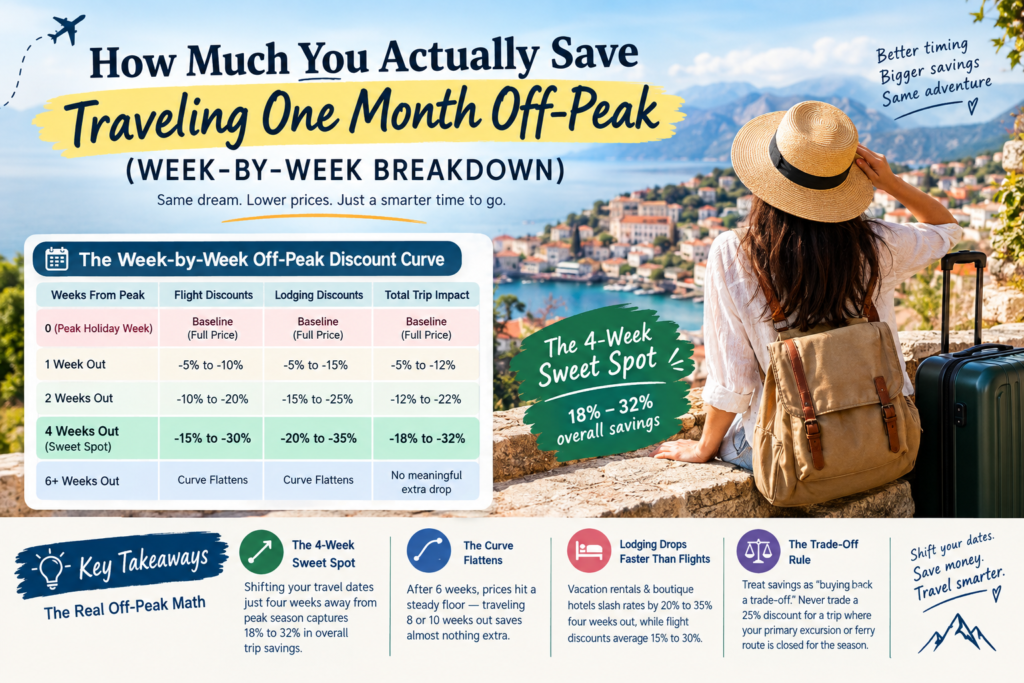
Key Takeaways: The Real Off-Peak Math
- The 4-Week Sweet Spot: Shifting your travel dates just four weeks away from peak season captures 18% to 32% in overall trip savings without risking major weather disruptions or shuttered attractions.
- The Curve Flattens: Flight and hotel prices do not drop indefinitely. Once you pass the 6-week post-peak threshold, rates hit a steady floor—traveling 8 or 10 weeks out saves almost nothing extra.
- Lodging Drops Faster Than Flights: Vacation rentals and boutique hotels slash rates by 20% to 35% four weeks out, while flight discounts average 15% to 30%.
- The Trade-Off Rule: Treat savings as “buying back a trade-off.” Never trade a 25% discount for a trip where your primary excursion or ferry route is closed for the season.
Shifting travel dates by a few weeks is one of the most frequently recommended pieces of travel advice, yet specific savings numbers are rarely pinned down. While travel providers speak vaguely about “shoulder season bargains,” real-world savings follow a measurable, predictable trajectory based on yield-management algorithms and hotel occupancy targets.
Rather than dropping indefinitely, travel expenses follow a curve: prices peak during the highest two or three weeks of vacation demand, taper sharply over the next four weeks, and then plateau into a baseline rate. Understanding the exact geometry of this curve prevents you from shifting your dates too far into the off-season where bad weather and reduced services outweigh any financial advantage.
The Week-by-Week Off-Peak Discount Curve
Why Moving Further Out Doesn’t Save More
A common mistake travelers make is assuming that if shifting 4 weeks saves 25%, shifting 8 or 10 weeks will save 50%. In reality, pricing hits an operational baseline. Airlines cannot fly planes below operating fuel costs, and hotels cannot rent rooms below their daily housekeeping overhead.
Once prices reach this “normal demand” floor (around the 5-to-6 week mark), the curve levels off completely. Traveling two months out delivers virtually identical prices to traveling one month out, while unnecessarily exposing you to winter weather and seasonal business closures.
Why Flights and Lodging Discount on Different Timelines
Airline Fare Dynamics: High Volatility
Airlines use real-time demand algorithms that react to how fast seats are selling on a specific flight. A route can drop unexpectedly if bookings lag, or surge if a conference is booked. Consequently, flight prices are noisier and require automated price tracking rather than calendar assumptions.
Lodging Rate Dynamics: Calendar Stability
Hotels, boutique inns, and vacation rentals set their seasonal rate calendars months in advance. Their price adjustments follow a much smoother, calendar-aligned drop. A 4-week shift almost always delivers predictable lodging discounts that hold steady until check-in.
How Destination Type Changes the Curve’s Shape
The steepness of the discount curve depends heavily on the destination’s primary attraction:
- Weather-Dependent Destinations (Beaches, Ski Resorts, National Parks): Experience a steep, compressed curve. Within 2 to 3 weeks after summer or ski season ends, rates plunge by 30% to 40% immediately and remain frozen at the floor until the next peak.
- Major Metropolitan & Cultural Hubs (London, Tokyo, New York): Exhibit a shallow, gradual curve. Because business travelers and year-round cultural tourists maintain baseline demand, moving four weeks out produces steady, moderate savings (10% to 18%) rather than dramatic plunges.
The Qualitative Filter: When a 25% Discount Isn’t Worth It
Never evaluate a date shift purely on financial percentages. Treat savings as “buying back a trade-off”:
- If shifting 4 weeks saves \$600, but the primary boat tour or hiking trail you traveled across the world to see is closed for the season, that \$600 discount is an expensive compromise.
- If shifting 2 weeks saves \$350 and keeps 100% of local infrastructure, restaurants, and sunny weather intact, the smaller discount represents vastly superior overall value.
The 3-Window Booking Test
Before confirming your trip dates, run this quick 5-minute price test across three distinct windows:
- Quote Baseline Dates: Price your flights and lodging for your ideal peak dates.
- Quote +2 Weeks Out: Check if rates drop by at least 15%. If the 2-week drop is steep, you may not need to move your dates any further.
- Quote +4 Weeks Out: If the 4-week quote delivers a further 10% to 15% discount without introducing weather hazards, you have identified your optimal booking window.
Frequently Asked Questions (FAQ)
1. Does shifting your trip dates by two months save twice as much as one month?
No. After roughly 5 to 6 weeks from peak demand, prices hit a baseline floor dictated by hotel overhead and airline operating costs. Traveling eight weeks out delivers virtually the same rates as traveling four or five weeks out.
2. Do international trips show bigger off-peak savings than domestic flights?
Yes. Long-haul international leisure routes (such as US or Europe to Southeast Asia or the Mediterranean) experience wider seasonal price swings (often 25% to 40% drops), whereas domestic business routes have steady year-round demand that keeps swings narrower.
3. Why does lodging drop in price more predictably than flights?
Hotels and vacation rental hosts typically program fixed seasonal rate tiers months in advance, creating steady calendar-based drops. Airlines rely on continuous algorithmic pricing that fluctuates daily based on seat sales and capacity.
4. What is the single best month for shoulder-season travel?
For the Northern Hemisphere, late April to May (spring shoulder) and late September to October (fall shoulder) consistently offer the sweet spot: 20% to 30% savings with warm weather and fully operational infrastructure.