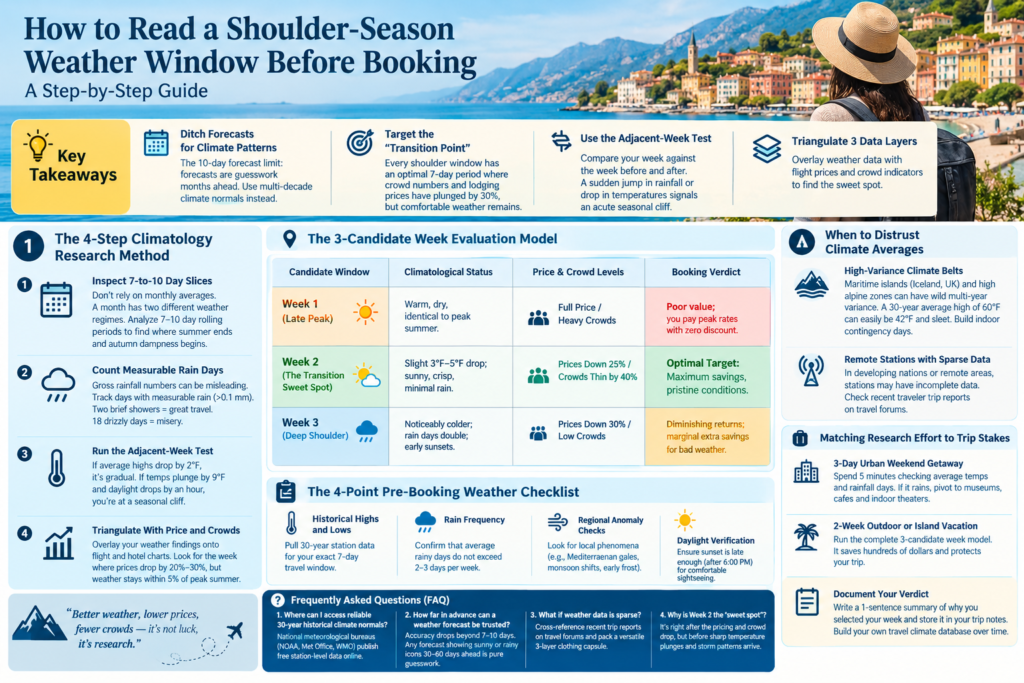
Key Takeaways: Ditch Forecasts for Climate Patterns
- The 10-Day Forecast Limit: Weather forecasts are mathematically useless months ahead. Trips booked in advance must be grounded in multi-decade historical climate normals for that specific calendar week.
- Target the “Transition Point”: Every shoulder window has an optimal 7-day period where crowd numbers and lodging prices have plunged by 30%, but comfortable weather remains intact.
- The Adjacent-Week Test: Compare your candidate travel week against the week before and the week after. A sudden jump in rainfall or drop in temperatures signals an acute seasonal cliff.
- Triangulate 3 Data Layers: Never evaluate weather in isolation. Overlay historical weather data onto flight price movement and regional crowd indicators to find the sweet spot.
Booking a shoulder-season vacation around an optimistic weather guess is one of the most common mistakes travelers make. Long-range 60-day or 90-day forecasts found on casual mobile apps are essentially statistical guesswork. Commercial meteorological forecast models maintain meaningful predictive skill only 7 to 10 days into the future.
However, what does exist—and what is far more dependable—is multi-decade climatological data. By analyzing historical temperature medians, tracking days with measurable rain, and spotting the specific calendar week where seasonal prices drop faster than the temperature, you can book off-peak vacations with near-peak conditions.
The 3-Candidate Week Evaluation Model
The 4-Step Climatology Research Method
1. Inspect 7-to-10 Day Slices
Never settle for monthly climate averages. A month like September or May contains two completely different weather regimes. Always analyze 7-to-10 day rolling periods to pinpoint where summer ends and autumn dampness begins.
2. Count Measurable Rain Days
Gross rainfall numbers (inches/millimeters) are deceptive. A region that receives 3 inches of rain from two brief afternoon cloudbursts offers great travel. The same 3 inches spread across 18 drizzly days creates misery. Track days with measurable rain (>0.1 mm).
3. Run the Adjacent-Week Test
Compare your target calendar week against the week immediately before and after. If average high temperatures drop by 2°F, the change is gradual. If temperatures plunge by 9°F and daylight drops by an hour, you are straddling an acute seasonal transition point.
4. Triangulate With Price and Crowds
Overlay your weather findings onto flight and hotel search charts. Your objective is to find the week where airfare algorithms have slashed prices by 20% to 30%, but historical weather data shows conditions remain within 5% of peak summer levels.
The 4-Point Pre-Booking Weather Checklist
- Historical Highs and Lows: Pull 30-year station data for your exact candidate 7-day travel window.
- Rain Frequency: Confirm that average rainy days do not exceed 2 to 3 days per week.
- Regional Anomaly Checks: Search for localized meteorological phenomena (e.g., Mediterranean autumn gale winds, tropical monsoon shifts, or early alpine frost).
- Daylight Verification: Ensure official sunset occurs late enough (after 6:00 PM) to allow comfortable afternoon sightseeing.
When to Distrust Climate Averages
Climate normals indicate probabilities, not absolute guarantees. Be cautious in two specific scenarios:
- High-Variance Climate Belts: Maritime islands (like Iceland or the UK) and high alpine zones exhibit wild multi-year variance. A 30-year average high of 60°F can easily manifest as 42°F and driving sleet. Always build in indoor contingency days.
- Remote Stations with Sparse Data: In developing nations or remote wilderness areas, meteorological stations may have recorded incomplete multi-year data. Back up official data by checking recent on-the-ground traveler trip reports on travel forums.
Matching Research Effort to Trip Stakes
Never over-engineer research for low-stakes travel. Calibrate your weather research to the scale of the trip:
- 3-Day Urban Weekend Getaway: Spend 5 minutes checking average temperatures and rainfall days. If it rains, you can easily pivot to world-class art galleries, cafes, and indoor theaters.
- 2-Week Outdoor or Island Vacation: Run the complete 3-candidate week model. With non-refundable resort deposits and outdoor excursions at stake, identifying the precise seasonal transition point saves hundreds of dollars and protects your trip.
- Document Your Verdict: Write a 1-sentence summary of why you selected your chosen week and store it in your trip notes. Over several journeys, you build an invaluable personal dataset of destination seasonal behavior.
Frequently Asked Questions (FAQ)
1. Where can I access reliable 30-year historical climate normals?
National meteorological bureaus (such as NOAA in the United States, the UK Met Office, and the World Meteorological Organization) publish free, station-level climate normals online, broken down by week and month.
2. How far in advance can a weather forecast be trusted?
Forecast accuracy deteriorates rapidly beyond 7 to 10 days. Any forecast showing sunny or rainy icons 30 or 60 days in advance is pure statistical extrapolation and should never be used to confirm non-refundable travel bookings.
3. What should I do if historical weather data for my destination is sparse?
If you are visiting a remote region without dense weather stations, cross-reference recent trip reports on travel forums from the past two years, and pack a versatile 3-layer clothing capsule to handle unexpected temperature swings.
4. Why is Week 2 in the candidate model considered the ‘sweet spot’?
Because it sits right after the seasonal pricing and crowd drop (which happens immediately after peak summer concludes), but well before the sharp temperature plunges and storm patterns of deep autumn arrive.