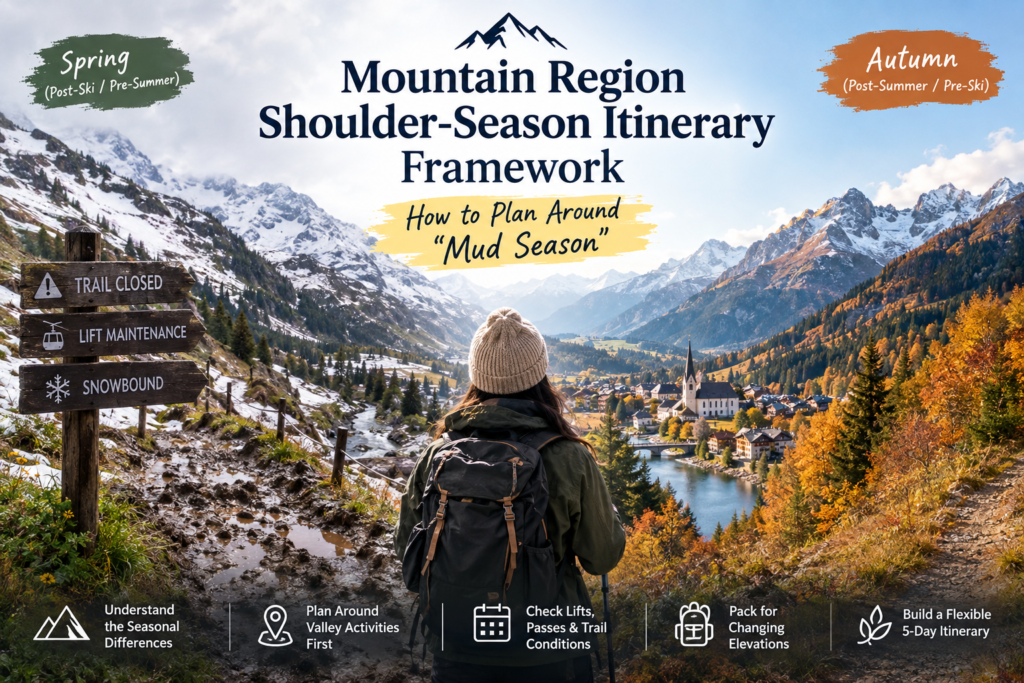
Mountain destinations do not follow the familiar rhythm of coastal or city shoulder seasons. While an off-peak beach trip is simply cooler and quieter, the inter-season period in alpine regions—often called “mud season”—introduces genuine operational shutdowns. In the quiet gap between ski season closing and summer hiking opening, high-altitude passes remain blocked by lingering snow, trails turn to deep slurry, and gondolas shutter for scheduled annual maintenance.
🏔️ Key Takeaways: Planning Mountain “Mud Season”
- Access cuts vs. weather cuts: Unlike coastal getaways, mountain shoulder seasons bring physical barriers: mechanical lift closures, impassable passes, and seasonal trail restrictions.
- Spring vs. Autumn: Spring brings melting snowpack, runoff, and deep mud; Autumn offers firmer trails and crisper air, constrained primarily by shorter daylight.
- The reverse-planning rule: Build your trip around guaranteed, low-elevation valley activities as the primary anchor. Treat high-altitude hikes and ridge excursions purely as conditional bonuses.
- Check elevation, not general forecasts: A warm, sunny 18°C valley afternoon often sits just 20 minutes away from a freezing, sleet-covered trailhead 1,000 meters higher.
Spring vs. Autumn Mud Season: Why the Window Matters
Most alpine hubs experience two separate shoulder windows each year, and they behave entirely differently underfoot. Choosing between them dictates your realistic trail access:
The “Reverse-Planning” Method for Mountain Travel
Standard mountain travel planning starts with a bucket-list alpine hike or cable car ride, with valley activities added as filler. In shoulder season, this approach frequently leads to disappointment when lift gates are locked or trailheads are flagged dangerous by rangers.
Instead, plan in reverse: start by compiling confirmed activities located on the valley floor that run 365 days a year. Use these stable foundations to establish the trip’s core schedule. Next, identify two or three high-altitude excursions that you treat strictly as conditional targets. If morning conditions, trail dryness, and cable-car operations line up, you execute the climb. If not, your day’s schedule remains completely intact without scrambling.
1. Audit the Town’s Base Elevation
Two mountain towns at the same latitude can offer completely different realities. A village at 800m base elevation will be dry, green, and completely walkable, while a resort town base at 1,800m will still be buried under soggy snow and closed storefronts.
2. Verify Mechanical Lift Calendars
Gondolas and funiculars undergo mandatory engineering overhauls in the shoulder months. These maintenance closures are published months in advance and do not budge for good weather. Check the operator’s official schedule directly.
3. Consult Local Outfitters 48 Hours Out
Guidebooks and general travel forums cannot track day-to-day melt rates or rockfall hazards. Reach out to local gear shops, municipal mountain guide offices, or your guesthouse host right before arriving for real-time trail safety updates.
4. Prioritize Booking Flexibility
Because alpine weather shifts rapidly and trails can close overnight due to localized runoff or late freezes, choose accommodation and activities that offer free cancellation or date-swapping over rigid non-refundable discounts.
A Resilient 5-Day Mountain Itinerary Blueprint
Here is how the reverse-planning framework translates into a concrete, five-day alpine travel schedule that holds up regardless of trail closures:
Arrive and settle into your base. Focus on paved riverside pathways, village architecture, or local lakeside circuits. This establishes a zero-risk opening day completely independent of lift schedules.
Evaluate current morning forecasts and trail reports. If an upper ridge trail or operational viewpoint lift is open, tackle it during peak daylight hours. Fallback backup: A lower-elevation gorge walk or castle visit.
Plan an indoor-friendly or sheltered regional excursion: thermal spas, craft breweries, regional food markets, or historic mountain chapels. This absorbs any fatigue and naturally handles rainy or poor-visibility weather.
Target a different geographical sector from Day 2 (such as a south-facing slope, which melts and dries out much faster than shaded north-facing trails). If trails are muddy, pivot to a scenic valley cycling route.
A slow breakfast, souvenir shopping at local farm shops, and departure via main valley transit lines. Avoid planning remote trailheads or long alpine transfers on your departure date.
⚠️ The Elevation Temperature Trap: Pack Load-Bearing Layers
Do not pack solely based on the base town’s forecast. Due to lapse rates, temperatures drop roughly 6.5°C per 1,000 meters of elevation gained. Combined with alpine wind chill, a mild valley morning can turn dangerously cold at higher passes. Always carry a waterproof windbreaker shell, a fleece mid-layer, and waterproof footwear with deep lugs that can handle slippery clay mud and wet slush.