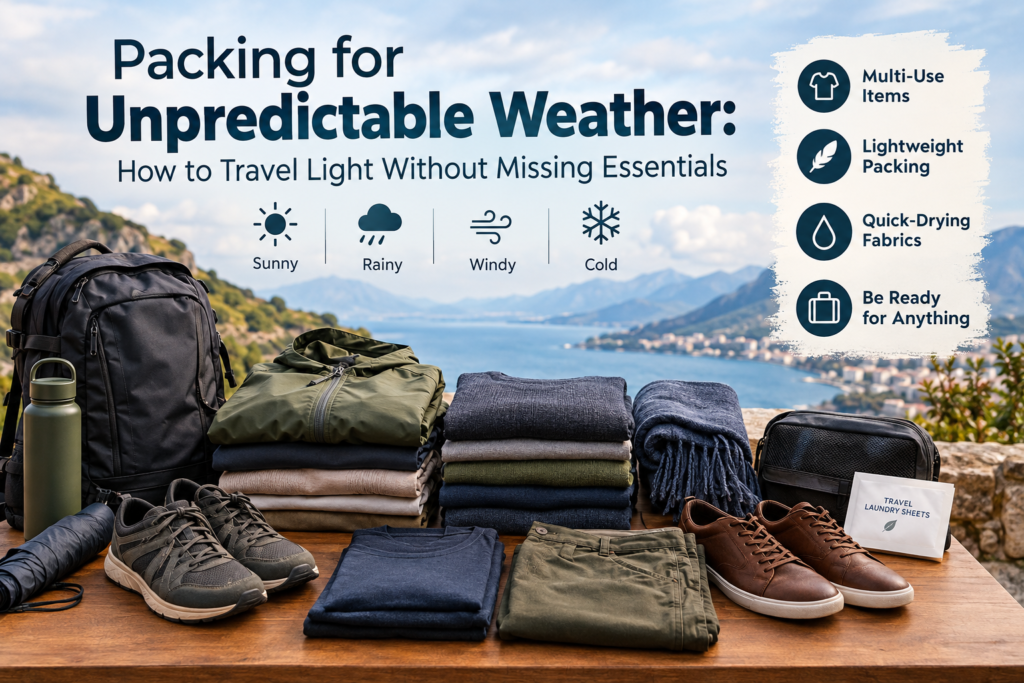
Key Takeaways: The Multi-Use Packing Discipline
- The Multi-Use Filter: Never pack an item that only serves a single hypothetical weather scenario. Every garment in your luggage must function across at least two realistic conditions.
- Ditch ‘Just-in-Case’ Bulk: Single-purpose heavy winter parkas and three pairs of slightly different shoes cause luggage bloat. Three modular layers combine to cover over 12 distinct temperature variations.
- Drying Speed is a Multiplier: Quick-drying merino wool or technical synthetics dry overnight on a hotel towel rack, cutting required clothing volume in half.
- The Floor Assembly Test: Lay out candidate garments and physically build out your three expected weather outfits using only what is on the floor. If an item is never picked, leave it at home.
The natural instinct when facing an uncertain shoulder-season weather forecast is to pack for every conceivable scenario: blazing sunshine, freezing mountain winds, coastal downpours, and formal dinners. That defensive mindset is precisely how carry-on bags end up overweight, cumbersome, and disorganized.
Packing effectively for volatile weather is not about carrying more clothes—it is about demanding that every single piece in your bag performs double or triple duty. By building a versatile wardrobe around multi-use items and rapid-drying fabrics, you can travel comfortably through 30°F daily swings with a single lightweight bag.
The Multi-Use Test: What Passes vs. What Fails
The 3-Step Scenario Packing Method
- Step 1: Define 2 to 3 Realistic Weather Scenarios: Use 30-year historical climate data to identify your destination’s actual probability bands (e.g., Scenario A: Sunny & 68°F; Scenario B: Breezy & 52°F; Scenario C: Rainy & 48°F). Do not invent freak 1-in-50-year blizzards.
- Step 2: Run the 2-Condition Utility Filter: Every garment must work in at least two of your identified scenarios. A technical tee works under a sweater in Scenario C and on its own in Scenario A.
- Step 3: Ruthlessly Purge Single-Use Items: If a jacket, shoe, or dress only works in a single narrow situation, remove it immediately unless it serves a life-safety function.
Regional MVP: The Hardest-Working Item by Destination
Temperate Coastlines (Mediterranean, Pacific NW)
MVP: The Vented Rain Shell. Coastal weather swings revolve around sudden ocean winds and damp mist. A breathable shell with pit zips blocks chilly sea breezes while preventing clamminess during urban hill walks.
Alpine & High-Altitude (Alps, Rockies, Andes)
MVP: Packable Down Jacket. In thin mountain air, sunny afternoons drop like a stone the second the sun dips behind a ridge. A high-fill down jacket offers crucial warmth while stuffing down to the size of a water bottle.
Subtropical & Humid Zones (Southeast Asia, Florida)
MVP: Quick-Dry Synthetics + Compact Umbrella. In 85% humidity, heavy waterproof shells trap body heat and sweat. Moisture-wicking base layers and a durable umbrella keep you dry without turning into a portable sauna.
The Last-Minute Duplicate Trap
The most common way light packing lists get sabotaged occurs 20 minutes before departure: you nervously toss in a second fleece “just in case” or a backup pair of jeans.
The Rule: Two mid-weight jackets that perform the same thermal job do not add capability—they only add weight. Run through your bag one final time to eliminate functional duplicates before zipping up.
The 10-Minute Pre-Departure Floor Assembly Test
To mathematically prove that your packing list is airtight, execute this physical test before packing your suitcase:
- Lay Out Everything: Place every piece of clothing, footwear, and accessory onto the floor or bed.
- Physically Build Out Scenarios: Assemble your warmest expected outfit, your rainiest expected outfit, and your mildest sunny outfit using only the items in front of you.
- Identify Missing Pieces: If an outfit lacks wind protection or a clean base layer, you have found an authentic gap to fix.
- Cut Unpicked Garments: If a sweater or shirt was never picked for any of your realistic scenarios, leave it at home—it is dead weight.
Multi-Tasking Accessories: The Ultimate Space Savers
- Packable Daypack: Serves as your airline personal item under the seat, a grocery tote, and a lightweight hiking summit pack.
- Earth-Tone Colors: Grays, navies, and olives hide trail dust and city grime far better than whites or blacks, extending days between washes.
- Sink Wash Sheets: Pocket-sized travel laundry sheets allow you to wash your base layers in a bathroom sink, eliminating the need to pack 7 different shirts.
Frequently Asked Questions (FAQ)
1. How do I determine which two or three weather scenarios are realistic?
Check 30-year historical climate normals for your exact travel week rather than looking at general seasonal labels. Focus on median daytime highs, nighttime lows, and the average number of days with measurable rain.
2. Is it ever sensible to pack for a weather scenario that is unlikely?
Only when the consequences of being caught unprepared are severe or dangerous. For instance, if you are hiking high mountain passes where sudden unseasonal blizzards present hypothermia risks, a dedicated emergency thermal layer is fully justified.
3. Why are mid-tone neutral colors better for unpredictable travel weather?
Mid-tones (charcoal, olive, navy, slate) conceal water spots from sudden rain showers, street dust, and travel friction far better than bright whites or dark blacks, allowing you to wear garments repeatedly without looking unkempt.
4. How many pairs of shoes do I actually need for unpredictable weather?
Exactly two pairs: one versatile, water-resistant pair of supportive walking sneakers for daily sightseeing and travel days, and one low-profile dress shoe or lifestyle sneaker for dinners and alternate days.